
Most people only notice wayfinding when it fails. The car park with no clear route to the entrance, the hospital corridor that forgets to mention the department you came for, the office lobby where every lift looks the same. When wayfinding works, nobody remarks on it, because they simply arrive where they meant to go. That invisibility is the whole point, and it is also why wayfinding is so easy to underestimate as a design discipline.
This guide explains what wayfinding actually is, how a wayfinding system is put together, and why it is worth treating as a designed system rather than a set of signs bought at the end of a project. It is written for anyone specifying or commissioning a building, and it links through to xsign’s wayfinding work where the detail helps.
What wayfinding actually means
Wayfinding is the process of helping people navigate a physical space with confidence, and a wayfinding system is the coordinated set of signage and environmental cues that supports it. The word covers more than signs. It includes the logic of how a building is laid out, the terminology used to name places, the sequence in which information is given, and the visual language that ties it together. The signs are the visible part of a larger system.
The distinction that matters is between a schedule of signs and a wayfinding scheme. A schedule lists products. A scheme records decisions: where people enter, the routes they take, the points at which they need to make a choice, and the information they need at each of those points. One is a shopping list. The other is a design.
The four families of wayfinding signage
Almost every wayfinding scheme is built from four types of sign, and keeping them distinct is what makes a system easy to read.
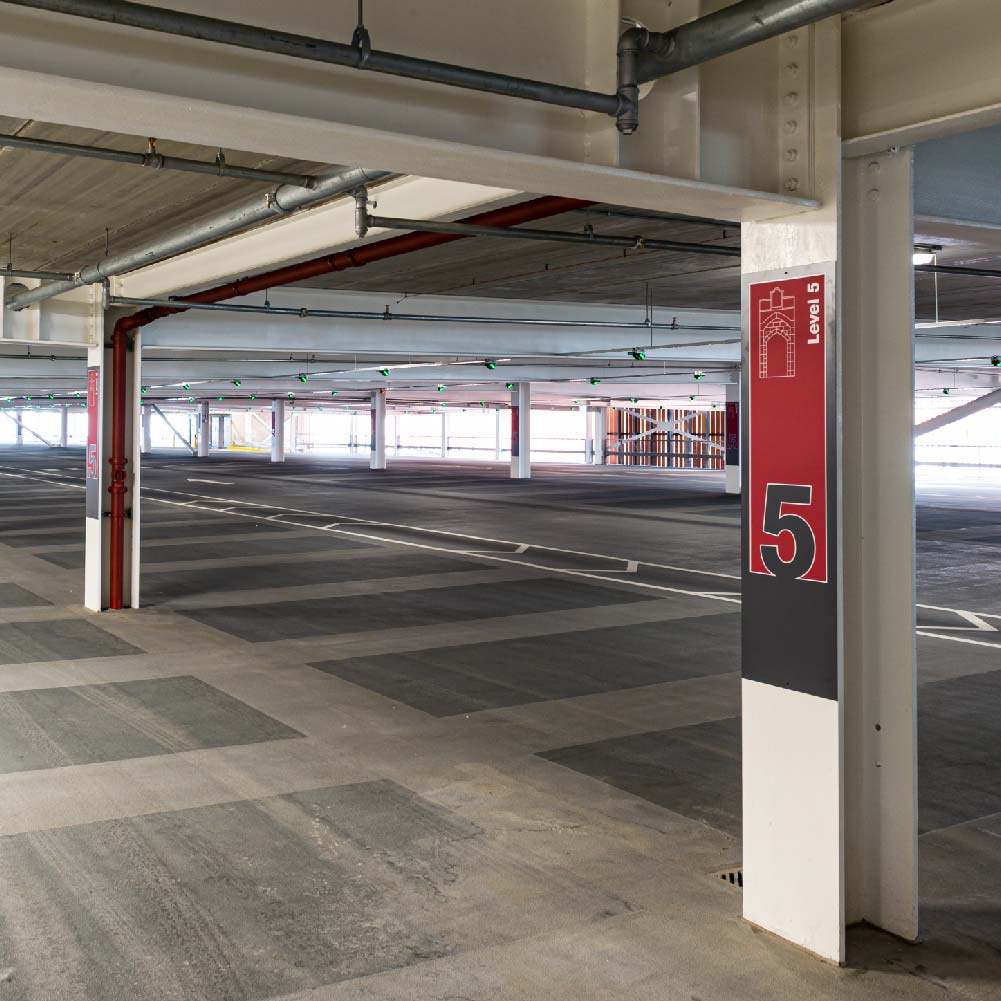
Identification signs
These confirm arrival. A building name, a department, a room number: the sign that tells you that you have reached the place you were heading for. Clear identification is what closes a journey.
Directional signs
These point the way at decision points. Positioned at junctions and choices, they answer the single question a person is asking at that moment: where do I go next? Good directional signage gives the answer at exactly the point it is needed, and no sooner.
Information signs
These orient. Directories, maps and opening times give an overview and help someone plan a route before they set off, usually near an entrance.
Regulatory and safety signs
These warn and instruct: fire exits, restricted areas, statutory safety information. They follow their own colour and shape conventions, and a good scheme keeps them legible without letting them clutter the navigational signage.
The principles that make wayfinding work
A wayfinding system succeeds on a few principles rather than on the quality of any single sign. The first is a clear information hierarchy, so a reader is given what they need in the order they need it: an overview at the entrance, confirmation at each junction, identification at the destination. Handing information over gradually, rather than all at once, is what stops a scheme overwhelming people.
The second is consistency. Once a visitor learns that a colour, a symbol or a position means a particular thing, they rely on that pattern without conscious effort. Break it, even with good intentions, and you force them back into reading every sign. The third is legibility, which is measurable: character height sized to viewing distance, and strong contrast between text and background. These are close to engineering tolerances, and BS 8300-2:2018 sets the numbers that keep a scheme readable and accessible.
Why wayfinding belongs in the design, not the fit-out
The decisions that shape wayfinding, where people enter and how they choose a route, are made by the architecture long before any sign is fixed. That is why the strongest schemes start as a strategy during design rather than a procurement at the end. Specifying wayfinding early, ideally by RIBA Stage 4, lets the signage coordinate with finishes, lighting and the building’s structure instead of working around them. There is a reasonable exception worth naming: a small building or a refurbishment where the layout is already fixed can sensibly bring wayfinding in a little later, since the architectural decisions are already made.

The cost of getting this wrong is felt after handover, in the retrofitted directory that does not match the layout and the laminated arrows taped to the wall. On the scheme we delivered at the Liverpool Tropical School of Medicine, wayfinding was written into the specification alongside finishes and ironmongery, which is what let a complex research building with public, semi-public and restricted zones read as one coherent place.
Wayfinding as part of the interior
A wayfinding scheme is not a separate layer stuck onto a finished building. It works best when its materials, typography and colour belong to the same design language as the wider interior signage, so navigation reinforces the architecture rather than competing with it. For a deeper, specification-level treatment aimed at architects, our specifier’s guide to wayfinding takes the principles here further into standards and detailing.
FAQs
What is wayfinding?
Wayfinding is the process of helping people navigate a physical space with confidence. A wayfinding system is the coordinated set of signage and environmental cues that supports it, covering the building’s layout logic, the terminology used to name places, the sequence in which information is given, and the visual language that ties it together, not just the signs.
What are the different types of wayfinding signs?
There are four families: identification signs that confirm arrival, directional signs that point the way at decision points, information signs such as directories and maps that orient, and regulatory or safety signs that warn and instruct. Keeping the four types visually distinct is what makes a wayfinding system easy to read.
What makes a wayfinding system effective?
Three principles: a clear information hierarchy that gives people what they need in the order they need it, consistency so a colour or symbol always means the same thing, and legibility with character heights and contrast set to BS 8300-2:2018. Effective wayfinding answers “where do I go now?” at each decision point without overwhelming the reader.
When should wayfinding be designed?
During design, ideally by RIBA Stage 4, not at the fit-out. The decisions that shape wayfinding are made by the architecture, so specifying it early lets the signage coordinate with finishes, lighting and structure. Small buildings or refurbishments with a fixed layout can sensibly bring it in a little later.
Is wayfinding just signage?
No. Signage is the visible part, but wayfinding also includes the building’s layout, the consistency of terminology, the sequence in which information is revealed, and the visual system that ties it together. A wayfinding scheme records navigational decisions, whereas a schedule of signs only lists products.
Designing wayfinding for your building
Wayfinding is a design discipline, not a shopping list, and it works best when it is planned as a system from the start. If you are developing a building and want navigation that supports the architecture rather than apologising for it, our team works with architects, specifiers and end clients from concept through to handover. Explore our wayfinding service or get in touch to talk through a project.