

Residential and student accommodation signage has a job most other schemes do not: it has to feel like home while working like infrastructure. A resident should read a scheme as warm and welcoming, but that same scheme has to guide first-time visitors, meet fire safety law, survive years of heavy use, and carry the operator’s brand across every touchpoint. Getting all of that into one coherent set of signs is what separates accommodation that feels considered from accommodation that feels like a corridor of numbered doors.
This guide sets out how to specify signage for residential and purpose-built student accommodation, covering brand, wayfinding, fire safety and durability, and draws on xsign’s residential signage work across the sector.
Brand and belonging at every touchpoint
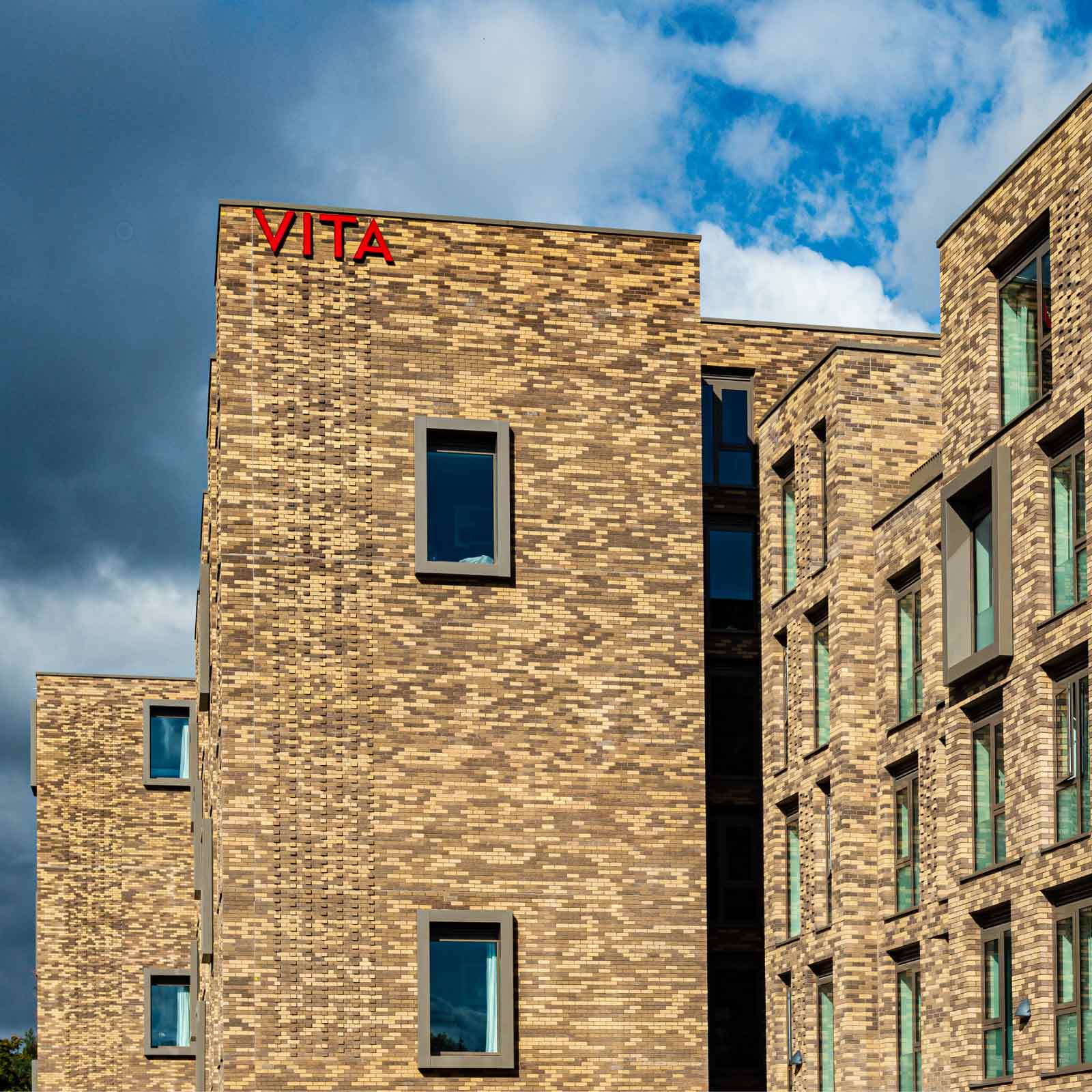
In the build-to-rent and student accommodation markets, the signage is part of the product. Residents are choosing an experience as much as a room, and the operator’s brand has to carry through the entrance, the amenity spaces, the lift lobbies and the corridors, not just the front door. Reception and feature signage set the first impression, and consistent branded wayfinding sustains it.
This is where material and finish choice does real work. A warmer palette, considered lighting and a strong reception piece make a building feel residential rather than institutional. On the scheme we delivered at Canvas Student Wembley, the signage was designed to carry the operator’s identity through the whole building so that the brand a resident chose online is the brand they live with.
Wayfinding for residents and visitors alike
Accommodation wayfinding serves two audiences with different needs. Residents learn the building quickly and then navigate on memory, so for them the priority is clear, consistent identification of floors, cores and rooms. Visitors, deliveries and contractors are reading the building cold, so they need a legible arrival sequence and directional signage from the entrance to the lifts and beyond. A scheme that assumes everyone is a resident leaves visitors stranded in the lobby.
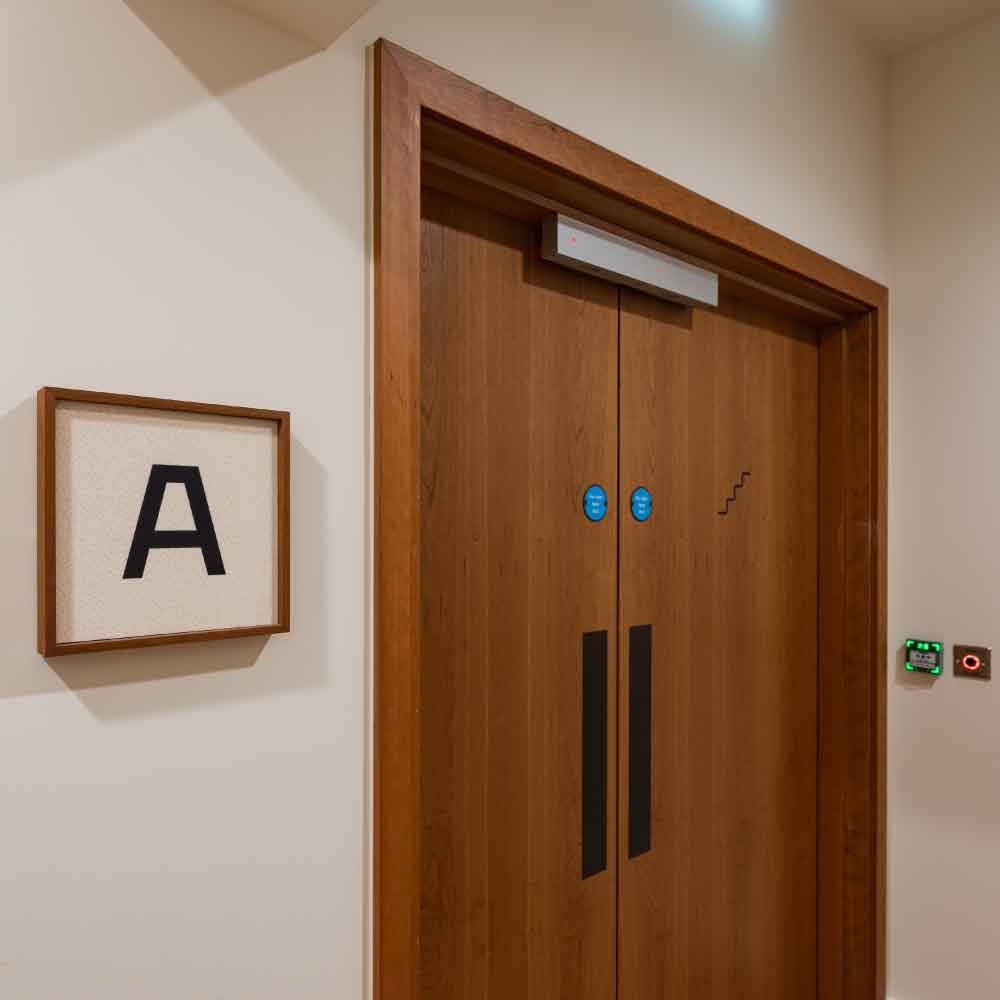
Clear floor and core identification matters more in accommodation than people expect, because large residential buildings often repeat near-identical layouts on every floor. Strong, consistent level and wing signage is what stops the disorientating experience of stepping out of a lift unsure which way is home.
Fire safety is not optional
Residential buildings carry statutory fire safety obligations that signage is directly part of. The Regulatory Reform (Fire Safety) Order 2005 requires clear signage for escape routes, fire equipment and fire safety information, and in accommodation this has to be woven into the scheme rather than added as an afterthought that clashes with the branded signage around it. Escape route signage that stays visible if the power fails, correct fire door signage, and clear fire action notices are all requirements, not options.
The design task is to make statutory signage read as a deliberate, well-placed layer of the same scheme rather than a set of mismatched notices. It also has to meet accessibility requirements: BS 8300-2:2018 sets the contrast and character-height detail that keeps residential signage usable for everyone.
Built to take years of heavy use
Accommodation is hard on signage. High resident turnover, deliveries, moving-in weekends and constant daily use test every fixing and finish. Material choice decides whether the building still looks cared-for after a few intakes. Modular systems with changeable inserts handle the reality that room and amenity uses change, while coated aluminium and stainless steel handle external identification and totems. There is a trade-off worth naming: the softest, most residential-feeling finishes are not always the most durable, so the specification usually balances warmth in amenity spaces with harder-wearing materials where traffic is heaviest.
Amenity spaces and the shared experience
Modern accommodation, especially in the student and build-to-rent markets, sells its shared spaces as much as its rooms. Gyms, study lounges, cinema rooms, co-working areas and social spaces are part of what a resident is paying for, and signage is how those spaces are branded, found and understood. Amenity signage does two jobs at once: it directs residents to facilities they might not otherwise discover, and it reinforces the operator’s brand in the places residents photograph and share.
This is where the scheme can be most expressive. Feature graphics, room-naming with personality, and considered material choices turn a corridor of function rooms into a set of destinations, and they carry the brand into the interior signage a resident sees every day. On the scheme at Chapter Living London Bridge, the amenity and wayfinding signage was designed to make the shared spaces feel like part of the offer rather than an afterthought. The design decision is to let the amenity signage carry more brand personality than the statutory and identification signage, while keeping them recognisably part of one family.
FAQs
What signage does student accommodation need?
Purpose-built student accommodation needs branded reception and amenity signage, clear floor, core and room identification for residents, an arrival and directional sequence for visitors and deliveries, and statutory fire safety signage. The scheme should carry the operator’s brand consistently while meeting fire safety and accessibility requirements.
What fire safety signage is required in residential buildings?
The Regulatory Reform (Fire Safety) Order 2005 requires clear escape route signage, fire equipment identification and fire safety information. Escape route signage should remain visible if power fails, fire doors need correct signage, and fire action notices must be clear. This has to be integrated into the scheme, not added as mismatched notices.
How do you make accommodation signage feel residential?
Use warmer materials and finishes, considered lighting, and a strong branded reception piece, so the building reads as a home rather than an institution. Carry the operator’s brand consistently through entrance, amenity spaces and corridors. Balance those softer finishes with harder-wearing materials where traffic is heaviest.
Why is floor identification so important in accommodation?
Large residential buildings often repeat near-identical layouts on every floor, so the moment someone steps out of a lift is the most disorientating point in the building. Large, consistent, well-placed floor and wing identification is what prevents that confusion, and it matters more than directional signage elsewhere in the scheme.
What materials suit residential signage?
Modular systems with changeable inserts cope with changing room and amenity uses and heavy turnover. Coated aluminium and marine-grade stainless steel handle external identification and totems. The specification usually balances warmer, residential-feeling finishes in amenity areas with more durable materials in high-traffic circulation.
When should accommodation signage be specified?
During design, so brand, wayfinding, fire safety and amenity signage are planned as one scheme rather than ordered separately near handover. Early specification lets the statutory fire signage sit within the branded scheme instead of clashing with it, coordinates fixings and power for illuminated feature signs, and gives fabrication lead times room to align with the construction and fit-out programme.
Specifying residential signage for your project
Residential and student accommodation signage works when brand, wayfinding, fire safety and durability are designed together into one scheme that feels like home and performs like infrastructure. If you are developing accommodation and want the signage to carry the brand while meeting every requirement, our team works with developers, operators and architects from concept through to installation. Explore our residential signage service or get in touch to talk through a scheme.